Career counselling is changing.
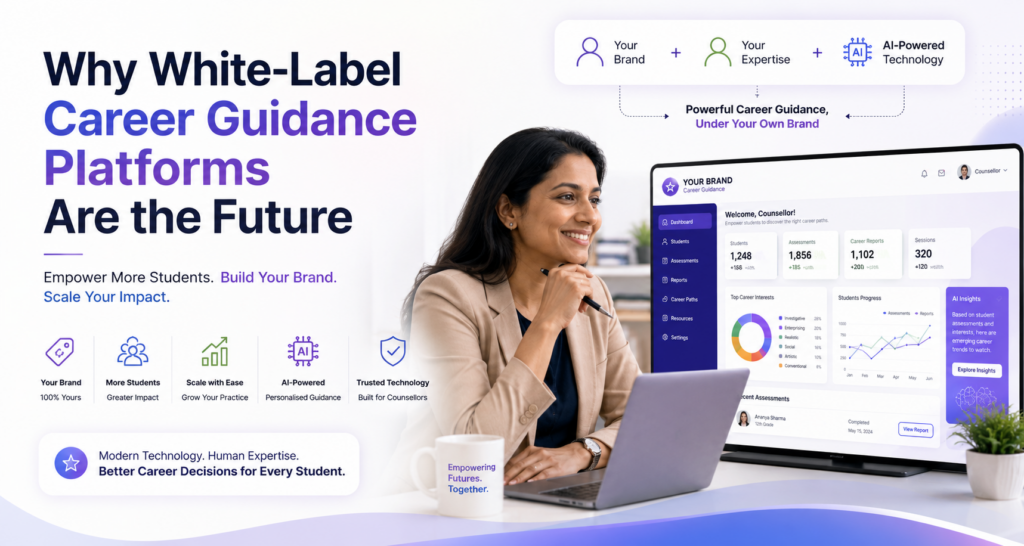
Students today don’t just expect a conversation about which course or career they should choose. They increasingly expect assessments, personalised recommendations, detailed career information, digital reports and clear guidance on what they should do next.
Parents expect more too. They want career recommendations to be backed by evidence and want to understand why a particular career may suit their child.
For independent career counsellors and counselling organisations, this creates both an opportunity and a challenge.
The opportunity is to provide a much richer career guidance experience.
The challenge is delivering all of this without investing significant time and money into developing your own technology.
This is where a white-label career guidance platform can make a major difference.
Instead of building assessment tools, career databases, recommendation engines and student dashboards from scratch, counsellors can use an existing technology platform and deliver the experience under their own brand.
It allows counsellors to combine what they do best—understanding and guiding students—with technology that helps them deliver that guidance at scale.
What Is a White-Label Career Guidance Platform?
A white-label career guidance platform is a ready-to-use digital career guidance solution that counsellors can offer to students under their own brand.
Depending on the platform, it may include capabilities such as:
- psychometric assessments
- personality assessments
- career-interest assessments
- aptitude assessments
- career recommendations
- career information
- personalised career paths
- student reports
- counsellor dashboards
- student progress tracking
Instead of sending students to several unrelated websites or assessment providers, the counsellor can provide a more integrated experience.
Most importantly, the counsellor’s brand remains at the centre of that experience.
The technology works behind the scenes.
Why Is Career Counselling Becoming More Technology-Driven?
Career choices have become significantly more complex.
A student interested in technology, for example, is no longer choosing simply between “IT” and “Computer Engineering.”
They may need to explore careers such as:
Artificial Intelligence Engineer, Data Scientist, Cybersecurity Analyst, Cloud Engineer, UX Designer, Robotics Engineer, Product Manager, AI Researcher and many others.
The same expansion is happening across healthcare, finance, design, media, sustainability, biotechnology, sports, business and other industries.
At the same time, new careers are emerging faster than traditional career guidance material can keep up.
This creates an important shift.
Career counselling is moving from:
“Which career should I choose?”
towards:
“Which careers fit my personality, interests and abilities—and how do I prepare for them?”
Answering that second question requires much more information.
Technology can help counsellors organise and interpret that information.
The Traditional Career Counselling Model Has a Scaling Problem
Consider an independent counsellor working with 100 students.
For every student, the counsellor may need to:
- understand the student’s background
- assess interests
- assess personality
- evaluate aptitude
- interpret the results
- research suitable careers
- prepare recommendations
- explain those recommendations
- create an action plan
- follow up with the student
Providing this level of personalisation manually requires considerable time.
As the number of students increases, the counsellor eventually faces a simple constraint:
There are only so many counselling hours available in a day.
This creates a difficult trade-off between personalisation and scale.
Technology changes that equation.
A digital career guidance platform can automate parts of the process that don’t necessarily require human intervention while allowing the counsellor to focus on the areas where human judgement matters most.
White-Label Platforms Combine Technology With Human Counselling
One misconception about AI-powered career guidance is that technology will replace career counsellors.
A better model is exactly the opposite.
Technology handles:
Assessment → Analysis → Information → Recommendations → Career Exploration
The counsellor handles:
Context → Interpretation → Conversation → Motivation → Decision Support
This distinction is important.
An algorithm might identify careers that match a student’s personality, interests and aptitude.
But it may not fully understand that:
- the student is afraid of moving away from home
- the parents have very different expectations
- the student lacks confidence despite strong ability
- financial constraints affect education choices
- the student is choosing a career because their friends are choosing it
- there is a conflict between what the student enjoys and what they believe is “safe”
These conversations require empathy, judgement and experience.
Technology therefore doesn’t need to replace the counsellor.
It can make the counsellor more effective.
7 Reasons White-Label Career Guidance Platforms Are the Future
1. Counsellors Can Offer More Than a Counselling Session
Traditionally, the main product of a career counsellor has been the counselling session itself.
A digital platform expands that offering.
Students can receive:
- assessments
- career recommendations
- career reports
- career exploration tools
- personalised career paths
- skill-development guidance
- ongoing access to career information
The counsellor moves from selling a session to providing a career guidance experience.
That is a much stronger value proposition.
2. Your Brand Remains at the Centre
Brand matters enormously for independent counsellors.
You’ve spent years developing credibility, building relationships with schools, generating referrals and earning the trust of parents and students.
If every student you counsel is redirected to another company’s platform, that company’s brand becomes part of your customer experience.
White-labelling changes this.
The technology becomes an extension of your counselling practice.
Students interact with a service associated with your brand rather than feeling that they have been sent to an unrelated third-party product.
This helps counsellors build something much more valuable over time:
their own career guidance brand.
3. Psychometric Assessments Become Part of a Larger Journey
Psychometric assessments are valuable—but the report should not be the end of career guidance.
Imagine a student receives the following result:
RIASEC profile: Investigative – Realistic – Conventional
Interesting.
But the student’s next question is usually:
“What does that mean for my career?”
Then:
“Which careers should I explore?”
And eventually:
“What should I actually do if I want to pursue one of them?”
This is where modern career guidance platforms can go beyond assessment.
A better journey looks like:
Assessment
↓
Understand Yourself
↓
Discover Suitable Careers
↓
Compare Career Options
↓
Choose Careers to Explore
↓
Build a Career Path
↓
Develop Skills and Experience
The psychometric assessment becomes the starting point of career planning rather than the final product.
4. AI Can Make Career Guidance More Personalised
Traditional career reports are often relatively static.
Students with similar assessment scores may receive similar career suggestions and similar descriptions.
AI creates an opportunity to move towards much deeper personalisation.
For example, career recommendations can potentially consider multiple dimensions such as:
Personality + Career Interests + Aptitude + Preferred Field + Skills + Career Aspirations
Instead of simply saying:
“Software engineering may suit you.”
A more personalised system can help answer:
- Why might this career suit me?
- Which of my strengths align with it?
- What skills do I need?
- What should I learn first?
- Which projects should I work on?
- What should I do during college?
- What alternative careers should I consider?
This changes the role of technology from generating a report to supporting an ongoing career journey.
5. Counsellors Can Serve More Students Without Compromising Personalisation
This may be the biggest commercial advantage.
Imagine the difference between manually preparing career recommendations for every student and having a platform prepare the initial assessment, analysis and career exploration material.
The counsellor can review the information before or during the counselling session.
Instead of spending much of the session collecting basic information and explaining assessment scores, more time can be spent discussing:
What does this mean for you?
That makes the counselling conversation more valuable.
It also allows counsellors to work with larger numbers of students without turning every additional student into the same amount of additional administrative work.
6. It Creates New Business Models for Career Counsellors
Technology doesn’t just improve counselling delivery.
It can change the economics of a counselling practice.
A traditional model might look like:
Student → Counselling Session → Payment
A platform-enabled model can look very different:
Student → Assessment → Career Guidance Platform → Counselling → Ongoing Career Planning
This creates opportunities for counsellors to package services differently.
For example:
Starter Package
Psychometric assessment + career report.
Career Discovery Package
Assessment + career recommendations + counselling session.
Career Planning Package
Assessment + counselling + personalised career paths + follow-up sessions.
Premium Guidance Programme
Ongoing career planning, skill development, profile building and periodic counselling.
Counsellors can therefore move beyond purely transactional one-time sessions towards longer-term student relationships.
7. You Don’t Need to Build Your Own Technology
Suppose a counselling organisation wanted to build its own digital platform.
It might require:
- website and application development
- psychometric assessment modules
- student authentication
- databases
- career information
- recommendation algorithms
- AI integration
- dashboards
- reports
- hosting
- cybersecurity
- backups
- software maintenance
- ongoing feature development
And building the first version is only the beginning.
Technology needs continuous maintenance.
Browsers change. Security requirements evolve. AI models improve. Career information needs updating. Students expect new features.
For most career counsellors, becoming a software company simply doesn’t make economic sense.
A white-label model provides another option:
Use the technology. Own the relationship. Build your brand.
From Career Counsellor to Career Guidance Platform
This may be the biggest long-term opportunity.
A counsellor traditionally builds a practice around their personal time and expertise.
But personal time doesn’t scale easily.
Technology allows the counsellor to start building something beyond themselves.
Instead of:
“Book a counselling session with me.”
the proposition becomes:
“Join my career guidance programme.”
That is a subtle but powerful difference.
The first sells the counsellor’s time.
The second sells a structured career development experience supported by the counsellor’s expertise.
For independent counsellors who want to grow their practice, work with schools or colleges, or serve students across different locations, this model can be particularly powerful.
What Should Counsellors Look for in a White-Label Career Guidance Platform?
Not every career guidance platform is designed around the needs of counsellors.
Before selecting one, consider whether it provides:
Recognised assessment frameworks
Understand what personality, interest and aptitude frameworks the platform uses.
Career recommendation capability
Assessment results should connect meaningfully with relevant career possibilities.
Personalisation
Students should not simply receive identical generic reports.
Career exploration
Students should be able to understand recommended careers rather than simply seeing a list of job titles.
Actionable career paths
The platform should help answer the student’s most important question:
“What should I do next?”
Counsellor visibility
Counsellors should be able to understand student results and use them during counselling conversations.
Branding
The student experience should reinforce the counsellor’s own brand.
Scalability
The platform should work whether you are counselling 20 students or working with schools serving hundreds or thousands.
And finally:
Technology should support your counselling methodology—not dictate it.
Where Does ByTrait Fit?
ByTrait has been designed around a simple idea:
Technology should empower career counsellors rather than compete with them.
Through its white-label offering, career counsellors can provide students with a technology-enabled career guidance experience under their own brand.
The platform brings together multiple elements of career discovery, including:
OCEAN Personality Assessment
Using the Big Five personality framework to help understand behavioural characteristics and personality strengths.
RIASEC Career Interest Assessment
Using Holland’s RIASEC framework to identify the types of activities and working environments that interest the student.
Aptitude Assessments
Exploring areas such as numerical ability, logical reasoning, language aptitude, spatial ability and mechanical reasoning.
AI-Powered Career Recommendations
Bringing different dimensions of the student’s profile together to identify careers worth exploring.
Personalised Career Paths
Helping students move beyond “Which career?” towards “How do I get there?”
The counsellor can then use these insights as part of their own counselling process.
The objective isn’t to automate counselling.
It is to automate the parts around counselling that technology can do well—so counsellors can spend more time doing what humans do best.
Listening. Understanding. Guiding.
The Future Is Not AI or Career Counsellors. It’s AI + Career Counsellors.
The debate around technology often focuses on whether AI will replace professionals.
For career guidance, that may be the wrong question.
A more useful question is:
What happens when an experienced career counsellor has better technology?
They can understand students faster.
They can provide richer information.
They can personalise recommendations.
They can create structured career plans.
They can support more students.
And they can potentially build a more scalable counselling practice.
The future of career guidance therefore may not belong to technology alone.
And it may not belong to traditional counselling alone.
It belongs to a model where human judgement and technology work together.
White-label career guidance platforms make that possible—while allowing the counsellor to remain exactly where they should be:
at the centre of the student’s career journey.
Bring AI-Powered Career Guidance Under Your Own Brand
If you’re a career counsellor looking to expand your services, a white-label career guidance platform can help you provide students with a richer digital experience without having to build the technology yourself.
With ByTrait, you can combine psychometric assessments, aptitude assessments, AI-powered career recommendations and personalised career paths with your own counselling expertise.
Your brand. Your students. Your counselling expertise. Powered by ByTrait.
Interested in seeing how it works? Request a ByTrait white-label demo.