Psychometric Assessment
Choosing a career is one of the biggest decisions a student makes. Yet, many students are expected to make this decision while they are still discovering their strengths, interests and abilities.
Should I choose engineering or design? Am I better suited to technology, business or creative careers? Which career matches my personality? Am I choosing a career because I genuinely enjoy it—or because everyone around me recommends it?
These are difficult questions.
A psychometric assessment can help students answer them in a more structured and objective way.
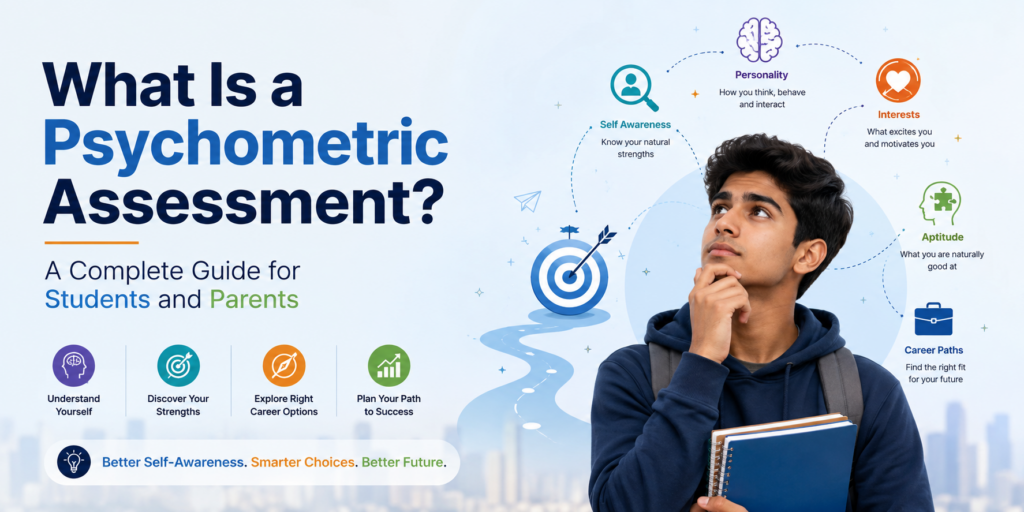
Rather than simply asking a student, “What do you want to become?”, psychometric assessments help uncover important characteristics such as personality, career interests, aptitude and natural strengths.
In this guide, we’ll explain what psychometric assessments are, how they work, what they measure, and how students and parents can use them to make better career decisions.
What Is a Psychometric Assessment?
A psychometric assessment is a structured method of measuring psychological characteristics and abilities such as personality, interests, aptitude, reasoning and behavioural preferences.
In career guidance, these assessments help build a better understanding of how a student thinks, what interests them, what they may naturally be good at, and what kinds of careers or working environments could suit them.
Think of it as creating a career profile of the student.
Instead of recommending a career simply because a student scored well in a particular subject, a good career assessment looks at several dimensions of the individual.
For example, two students may both perform well in mathematics.
One may enjoy solving complex technical problems independently, while the other may enjoy using numbers to analyse businesses and communicate insights to people.
Their academic ability may be similar, but their interests, personality and preferred working environments can be very different.
Psychometric assessments help identify these differences.
Why Are Psychometric Assessments Useful for Students?
Students today have far more career choices than previous generations.
Traditional options such as engineering, medicine, law, finance and government services now exist alongside rapidly growing fields such as:
- Artificial Intelligence and Data Science
- Cybersecurity
- Robotics and Automation
- UX/UI Design
- Digital Marketing
- Biotechnology
- Renewable Energy
- Game Development
- Climate Technology
- Content Creation
- Sports Analytics
- Behavioural Science
Having more choices is good—but it can also make career decisions more complicated.
Students are often influenced by marks, parents, friends, social media, popular career trends or the perceived earning potential of a profession.
A psychometric career assessment introduces another important piece of information:
Who is the student, and what kind of work might naturally suit them?
It doesn’t make the career decision for the student. Instead, it provides evidence that can support a better decision.
What Does a Psychometric Assessment Measure?
Not all psychometric assessments are the same.
For career guidance, three areas are particularly useful: personality, career interests and aptitude.
1. Personality
Personality assessments explore patterns in how someone typically thinks, behaves and interacts with others.
For example, a personality assessment may help identify whether a student tends to:
- enjoy social interaction or prefer independent work
- favour structured environments or flexibility
- explore new ideas and experiences
- work carefully and systematically
- remain calm or react strongly under pressure
- enjoy collaboration and helping others
One widely researched model used to understand personality is the Big Five personality model, often represented by the acronym OCEAN:
O – Openness to Experience
Preference for new ideas, imagination, creativity and exploration.
C – Conscientiousness
Tendency towards organisation, responsibility, planning and persistence.
E – Extraversion
Preference for social interaction, communication and energetic environments.
A – Agreeableness
Tendency towards cooperation, empathy and consideration for others.
N – Neuroticism / Emotional Sensitivity
Tendency to experience emotional reactions such as worry, stress or sensitivity.
Importantly, there is no “good” or “bad” personality profile.
Different characteristics can be valuable in different careers and working environments.
2. Career Interests
Being capable of doing something does not necessarily mean you will enjoy doing it every day.
That is why career interests are an important part of career planning.
One of the best-known frameworks for understanding career interests is Holland’s RIASEC model.
RIASEC groups career interests into six broad areas:
Realistic (R)
People who enjoy practical, physical or technical activities.
They may enjoy working with machines, equipment, tools, engineering systems or the physical environment.
Investigative (I)
People who enjoy analysing, researching and solving complex problems.
Science, technology, medicine, mathematics and research-oriented careers frequently involve Investigative interests.
Artistic (A)
People who enjoy creativity, imagination and self-expression.
Design, writing, media, performing arts and other creative fields may appeal to this interest type.
Social (S)
People who enjoy helping, teaching, supporting or developing others.
Education, counselling, healthcare and social services often involve strong Social interests.
Enterprising (E)
People who enjoy influencing, leading, persuading and taking initiative.
Entrepreneurship, management, business development and sales can involve strong Enterprising interests.
Conventional (C)
People who enjoy structure, organisation, accuracy and working systematically with information or processes.
Accounting, administration, operations and certain analytical roles may involve Conventional interests.
Most people are not purely one type.
A student might, for example, show strong Investigative + Realistic interests, which could point towards engineering and technology-oriented environments.
Another might show Artistic + Enterprising interests, suggesting a very different set of career possibilities.
3. Aptitude
Aptitude assessments look at a student’s ability or potential to perform certain types of tasks.
Depending on the assessment, these might include:
Numerical Ability – understanding numbers and solving quantitative problems.
Logical Reasoning – identifying patterns, relationships and logical solutions.
Language Aptitude – understanding and working effectively with language.
Spatial Ability – mentally visualising shapes, objects and spatial relationships.
Mechanical Reasoning – understanding basic mechanical and physical principles.
Aptitude is different from personality and interests.
A student may be highly interested in a field but discover that certain abilities need further development.
That doesn’t necessarily mean they should abandon the career.
Instead, it can help answer a much more useful question:
“What skills should I strengthen if I want to pursue this career?”
Personality vs Interests vs Aptitude: What’s the Difference?
These terms are sometimes used interchangeably, but they measure different things.
| Assessment | Main Question |
|---|---|
| Personality | How do I naturally tend to think and behave? |
| Career Interests | What kinds of activities and work do I enjoy? |
| Aptitude | What kinds of tasks am I naturally good at or capable of developing? |
A useful career assessment should not depend entirely on one of these dimensions.
Imagine a student who has excellent numerical ability.
Does that automatically mean they should become an accountant, engineer or data scientist?
Not necessarily.
Their interests and personality could make some of those careers far more satisfying than others.
The real value comes from looking at multiple dimensions together.
How Does a Psychometric Career Assessment Work?
A typical assessment involves a student responding to a series of questions or completing short exercises.
The answers are then scored against established dimensions.
A career-focused assessment may follow a process such as:
Assessment → Student Profile → Career Matching → Career Exploration → Career Plan
The important part is what happens after the test.
A psychometric score by itself has limited value.
The results need to be interpreted and connected to actual career possibilities.
A student should ideally come away understanding:
- their key personality characteristics
- their strongest career interests
- their aptitude profile
- career areas worth exploring
- why particular careers may suit them
- skills they may need to develop
- practical next steps
That turns a psychometric test from a report into a career planning tool.
Can a Psychometric Test Tell You the Perfect Career?
No—and students and parents should be cautious of any assessment claiming that it can.
There is no mathematical test that can say:
“You should become a software engineer.”
Career decisions are more complicated.
A student’s career choice may depend on personality, interests, aptitude, academic performance, skills, education, personal circumstances, values, opportunities and how industries evolve.
Psychometric assessments should therefore be treated as decision-support tools, not decision-making machines.
A good assessment helps narrow the possibilities and provides a structured starting point for career exploration.
The final decision still belongs to the student.
At What Age Should Students Take a Psychometric Assessment?
There isn’t one perfect age.
The purpose of the assessment changes as students progress through education.
Students in Classes 8–10
Assessments can help students understand their interests and strengths before making important academic and subject choices.
Students in Classes 11–12
Career assessments can support decisions around undergraduate courses, specialisations and career directions.
College Students
The focus can become much more specific—career roles, skill development, internships, projects, higher education and employability.
Psychometric assessments can also be repeated at different stages.
Students develop, gain new experiences and discover new interests. Career planning should therefore be viewed as an ongoing process rather than a one-time decision.
What Should Parents Look for in a Psychometric Assessment?
Not every online personality quiz is a psychometric assessment.
Before choosing an assessment for your child, look beyond a colourful report or a long list of recommended careers.
A useful career assessment should:
- use recognised psychological frameworks
- explain what is being measured
- assess more than one dimension where appropriate
- provide understandable results rather than just scores
- explain why particular career areas are suggested
- allow students to explore multiple career possibilities
- connect assessment results with practical career planning
Most importantly, the assessment should encourage exploration rather than labelling the student.
A 15-year-old should not walk away believing that a test has decided what they can or cannot become.
Common Myths About Psychometric Tests
Myth 1: A psychometric test decides your career
It doesn’t.
It provides information that can help you make a more informed career decision.
Myth 2: There are right and wrong answers
Personality and interest assessments generally aren’t exams.
Trying to give the answer you think looks “better” can actually make the results less useful.
Myth 3: High aptitude guarantees career success
Aptitude is only one part of the picture.
Motivation, interests, skills, learning, persistence and opportunities also matter.
Myth 4: Personality cannot change
Personality tends to show patterns, but people continue to develop through experience, education and changing environments.
Myth 5: One test is enough to plan your entire career
Career planning should involve assessment, exploration, research, conversations, experience and continuous skill development.
How ByTrait Uses Psychometric Assessment for Career Guidance
At ByTrait, we believe career guidance should go beyond simply generating a personality report.
ByTrait brings together different dimensions of a student’s profile to help them explore career possibilities that are relevant to who they are and what they are interested in.
The platform uses recognised frameworks including the Big Five (OCEAN) personality model and Holland’s RIASEC career-interest framework, along with aptitude assessments, to build a broader understanding of the student.
Instead of stopping at assessment results, students can use these insights to explore career options and understand the journey towards them.
The objective is simple:
Don’t tell students what they should become. Give them better information to decide what they could become.
Psychometric Assessments Are a Starting Point, Not the Final Answer
Career decisions shouldn’t be based purely on marks.
They shouldn’t be based purely on what friends are doing.
And they shouldn’t be based purely on the results of a psychometric test either.
The strongest career decisions come from combining self-awareness, evidence, exploration and real-world information.
A good psychometric assessment can provide the self-awareness part of that equation.
It can help a student understand:
Who am I? What interests me? What am I good at? What careers should I explore? What do I need to develop next?
Those are far more useful questions than simply asking:
“What should I become?”
Frequently Asked Questions
What is a psychometric assessment for students?
A psychometric assessment is a structured assessment used to understand characteristics such as a student’s personality, career interests, aptitude and behavioural preferences. In career guidance, these insights can help students identify and explore careers that may suit them.
Is a psychometric test the same as an aptitude test?
No. An aptitude test measures abilities such as numerical, logical, verbal or spatial reasoning. A psychometric assessment is a broader term and can include personality, interests, aptitude and other psychological characteristics.
Can psychometric assessments help in choosing a career?
Yes. They can help students understand themselves and identify career areas worth exploring. However, assessment results should be combined with academic performance, skills, aspirations, opportunities and career research.
Are psychometric tests accurate?
The quality of a psychometric assessment depends on factors such as the framework used, how the assessment was designed, how reliably it measures the intended characteristics, and how the results are interpreted. Recognised frameworks and properly designed assessments are preferable to informal online quizzes.
How long does a psychometric assessment take?
It varies considerably depending on what is being assessed. Some assessments take 15–30 minutes, while broader career assessments involving personality, interests and multiple aptitude areas may take longer.
Can parents use psychometric results to choose a career for their child?
The results are better used to start a conversation than to make the decision for the student. Parents can use the insights to understand their child’s strengths and interests and help them explore suitable opportunities.
Can I take a psychometric career assessment online?
Yes. Many psychometric and career assessments are available online. Students and parents should check what the assessment measures, which frameworks it uses and how the results are translated into meaningful career guidance.
Ready to Understand Your Career Profile?
Choosing a career doesn’t have to begin with guessing.
Understanding your personality, interests and aptitude can give you a clearer starting point for exploring the careers that may suit you.
Discover your strengths. Explore your possibilities. Build your career path with ByTrait.